

L'Alchimie Végétale, between science and poetry — how we compose 27 plants
Behind the scenes of L'Alchimie Végétale, World's Best Digestif 2025. Five plant families, four years of R&D, 32 documented trials. A technical and honest account.
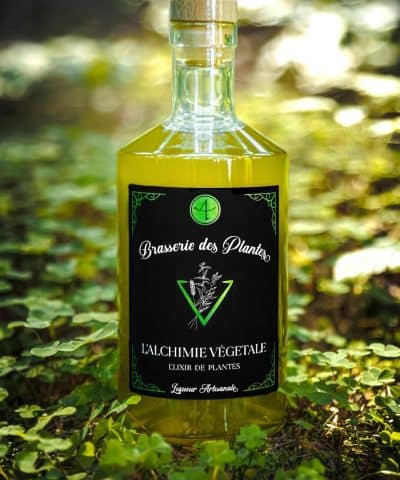
L’Alchimie Végétale was crowned World’s Best Digestif 2025 at the World Drinks Awards. The round number — 27 plants — fascinates. But behind the number, there is a method. This article tells how a complex blend is actually built, and what “working with 27 plants” means day to day.
Why 27 (and not 24 or 30)?
It’s not a magic number. It’s the result, after four years of R&D, of the blend that held up in blind tasting. We started from a simpler first draft, tried heavier versions (notes cancelled each other), and finally stabilised at 27 after many documented trials.
The 27 plants fall into five functional families — roots, herbs, flowers, spices, citrus. Each has a precise aromatic role: nothing is there for decoration.
The five families of the Alchimie
The roots structure the digestif and give the length on the palate — they are the backbone, the medicinal dimension inherited from the great amari.
The herbaceous heart makes the liqueur “breathe”. These are the aromatic plants harvested by our partner foragers and market gardeners (most of them organic).
The flowers bring roundness and aromatic finesse. They lay down the notes we identify first on the nose.
The spices and barks play the role of “salt”: without them, a liqueur becomes talkative and round. They bring tension.
The citrus avoids the “medicinal syrup” effect a complex liqueur can take on — they open, refresh, lighten.
The four production stages
Stage 1 — Long cycle (12 weeks) of roots in neutral alcohol at 70% vol., at room temperature, in closed stainless-steel tanks. Roots need time; flowers wouldn’t survive.
Stage 2 — Short cycle (72 hours) of herbs and flowers, in a second, less concentrated alcohol (45%), at cool temperature. Volatile aromas are better preserved cold and at lower strength.
Stage 3 — Spice infusion (48 hours) in warm alcohol (60°, tepid — not boiling). Heat better releases the essential oils from seeds and barks.
Stage 4 — Assembly and rest (8 weeks) — we bring the three preparations together in a single tank, adjust with sugar (just enough to balance, not to mask), and let it rest. It’s during these eight weeks that the blend “welds” together.
Total: about six months between the first plant and the bottle.
What has evolved over the years
The recipe has refined between the first versions and the one presented at the World Drinks Awards 2025. A few plants were added along the way to bring more depth or a longer finish — subtle additions that, in tasting, make the difference.
What the 27 plants do not do
For the sake of honesty:
- They don’t “cure” anything. The Alchimie is a pleasure digestif, not a medicinal infusion.
- They don’t guarantee the bottle is “better” than a 10-plant liqueur. A great Chartreuse has 130 plants; other great liqueurs have only a handful. Number is not a quality criterion, but a stylistic signature.
- They are not all grown on site. Six plants (cardamom, combava, star anise, cinnamon, liquorice, and others) come from international organic supply chains — impossible to grow in Haute-Loire.
What we keep from this recipe
L’Alchimie Végétale is as much an exercise in patience as an exercise in dosage. It resembles, in its own way, the craft of a perfumer: many ingredients, few proportions visible to the naked eye, a final signature that you recognise without being able to break it down.
Three years to land the recipe. One year to confirm it before sending it to London. And now, a lifetime ahead — provided we keep adjusting it, season after season.
Discover L’Alchimie Végétale: product page · Our full range.
Co-founder of La Brasserie des Plantes. Trained in plant biotechnology in Toulouse, he composes the recipes and oversees production.