

How to choose a craft liqueur: the complete guide for the thoughtful drinker
ABV, dominant plant, use case, sugar, traceability: the 5 criteria that really matter when picking a craft liqueur. A 10-minute read to never get it wrong — by La Brasserie des Plantes, World's Best Digestif 2025.
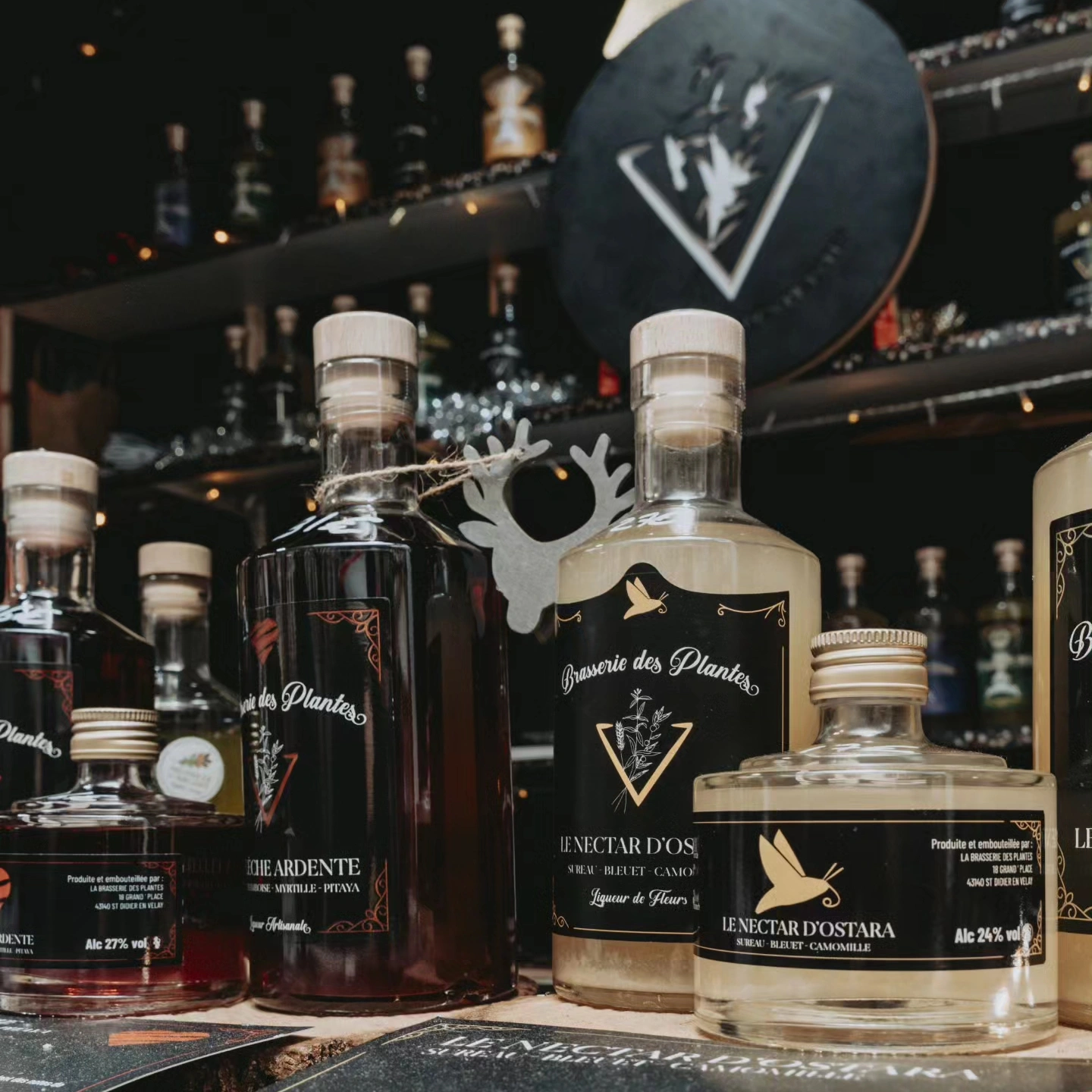
On any liqueur shelf, there’s everything and anything. Supermarket bottles at €9, coloured with E150d (ammonia caramel), flavoured with synthetic extracts. And next to them, €35-45 bottles signed by three craftspeople in a Haute-Loire village — like the ones we make.
How do you tell the difference? How do you pick the right liqueur for the right moment? And most importantly, how do you avoid marketing traps?
This is the guide we wish we’d found when we started, in 2021. It’s built around five objective criteria any buyer can verify. By the end, you’ll read a label like we do.
1. What is a liqueur, exactly?
European regulation (EU 2019/787) is precise:
A liqueur is a spirit drink containing a minimum of 15% ABV and at least 100 g of sugar per litre, obtained by flavouring an alcoholic base with fruits, plants, spices, flowers or creams.
Three keywords to remember:
- Spirit drink: an alcoholic base (different from a mutated wine or a cocktail).
- Flavoured with plant material: what distinguishes it from a simple spirit (whisky, rum, vodka).
- Mandatory sugar: minimum 100 g/L. Below that, it’s a “plant-based spirit” (like certain Italian amari).
The cousins not to confuse
- Bitter / Amaro / Bitter digestif: minimum 8% of bitter plant substances (gentian, cinchona, rhubarb). Less sweet than a classic liqueur.
- Elixir: historical term, often stronger (35-45% ABV), sometimes given to monastic liqueurs (Chartreuse, Bénédictine).
- Crème: minimum 250 g/L of sugar — very sweet, thick texture.
- Eau-de-vie / Plant-based spirit: doesn’t meet the sugar threshold. Absinthe, pastis, gin belong to this category.
In our range, we have:
- Liqueurs in the strict sense (L’Alchimie Végétale, L’Herbe des Druides, botanical aperitifs…), all above 100 g/L of sugar.
2. The 5 criteria that really matter
Criterion 1: alcohol content (% ABV)
It determines use and serving context.
| ABV | Category | Recommended use |
|---|---|---|
| 15-18% | Soft aperitif | Long drink, with tonic or sparkling |
| 18-25% | Bold aperitif | Neat, iced, or in cocktails |
| 25-35% | Medium digestif | End of meal, neat or on ice |
| 35-45% | Strong digestif | For contemplation, small pour |
| +45% | Elixir / rare | Neat tasting, micro-pour |
Our Cerf’Gent is 15.5% — designed for aperitif, served frozen as a French alternative to industrial gentian bitters.
Our L’Alchimie Végétale is 50% — a powerful digestif, crowned World’s Best Digestif 2025 at the World Drinks Awards. Small pour, room temperature.
Common trap: a 40° liqueur isn’t “better” than a 20° one. The right ABV depends on your use.
Criterion 2: the dominant plant or fruit
This is the heart of the aromatic profile. Everything else supports it.
The main botanical families:
- The bitters: yellow gentian, cinchona, rhubarb, artichoke, chicory. Length, structure. Perfect for digestif and bitter aperitif. → Cerf’Gent, L’Alchimie Végétale.
- The aromatics: lemon verbena, lemon balm, mint, thyme, rosemary, basil. Freshness, herbs, brightness. Ideal for aperitif and cocktail. → L’Herbe des Druides, Menthor.
- The florals: elderflower, violet, rose, lavender, hyssop. Delicate notes, fragrance, roundness. → Nectar d’Ostara.
- The citrus: bitter orange, combava, bergamot, mandarin. Liveliness, short finish, brightness. → Zéleste.
- The fruits: wild blueberry, elderberry, rowan, hawthorn. Body, roundness, ripe fruit.
- The spices: cinnamon, cardamom, star anise, ginger, clove. Warmth, depth, aromatic complexity. Usually supporting, rarely dominant.
Our advice: start with a family you already like (you drink verbena tea? Explore the aromatics. You love Campari? You’re a bitter fan).
Criterion 3: sugar level
Three regulated mentions:
- “Liqueur” alone: between 100 and 250 g/L of sugar.
- “Crème de…”: at least 250 g/L (very sweet).
- “Crème de cassis (de Dijon)”: protected PGI, at least 400 g/L (ultra-sweet).
The less sugar, the more readable the aromatic profile. A crème at 400 g/L “masks” the plants under a syrupy layer. A liqueur at 120 g/L lets the botanicals speak.
At our house, we average 150-180 g/L — in the low end of the liqueur bracket, because we want the verbena to talk, not the sugar.
Trap: large retail chains sell many “liqueurs” that are actually disguised crèmes (350+ g/L). Always check the sugar figure on the label — it’s mandatory in the nutritional values.
Criterion 4: composition — how many ingredients, from where?
A good liqueur usually has between 3 and 30 botanical ingredients.
Below 3: often simplistic, flavoured on a neutral base with no character.
Above 30: rare, complex, signature of advanced craftsmanship. L’Alchimie Végétale contains 27 plants — the densest composition in our range.
What to look for on the label or product page:
- The full plant list — craft houses display it with pride. Industrial producers hide behind “natural flavourings” (= authorisation to use up to 300 different aromatic molecules, all “natural” in the chemical sense).
- Origin of plants — organic? Traceable? Imported? A craft producer should be able to name its partner farms or describe its supply chain.
- No artificial colouring (E102, E150d, E133) — colour should come from the plants themselves (chlorophyll for green, quercetin for yellow, anthocyanins for red).
Criterion 5: traceability and batch size
A simple indicator: how many bottles are produced per year?
- Mass distribution: 100,000 to 10,000,000 bottles/year per SKU.
- Confidential craft: 500 to 5,000 bottles/year.
- Established craft (us): 5,000 to 50,000 bottles/year depending on the liqueur.
The smaller the batch, the more:
- quality control is fine-grained (every tank is tasted),
- the raw material can be traced plant by plant (no need for 10 tonnes of verbena),
- the producer can personally answer your questions.
Our rule: anyone who writes to us on Instagram or via email gets a reply within 48h, signed by one of the two founders. Try that with an industrial group.
3. Picking by use: our classification
Here’s how we recommend our 13 liqueurs by moment:
For aperitif
- Classic bitter (as a Suze alternative): Cerf’Gent, 15.5%, serve frozen or with tonic — Gold Medal at the CGA Paris 2025.
- Floral and fresh: Nectar d’Ostara, 24%, with crémant or simply on ice.
- Indulgent: Pralicoquine, 15.5%, praline-almond, on ice as a digestif-aperitif.
- Vibrant citrus: Zéleste, 17.5%, with tonic and an orange peel.
For digestif
- The trophy: L’Alchimie Végétale 50%, World’s Best Digestif 2025. 27 plants, our signature.
- The floral alternative: L’Herbe des Druides, 28%, verbena, wild thyme (serpolet), caraway — multi-medalled at the Lyon competition.
- The rare one: L’Alchimie Cuvée Michel, numbered tribute, limited edition.
For cocktails
- Floral base: Nectar d’Ostara in a flower spritz.
- Bitter base: Cerf’Gent in a French Negroni.
- Mint base: Menthor in a revisited Mojito.
Full recipes on our cocktails page.
For gifts or discovery
Build your own 3-bottle gift box from the full range — our 20 cl bottles stack naturally thanks to a patented format.
For relaxation (specific profile)
4. Advice by drinker profile
If you’re a beginner
Start with a liqueur you can drink as a long drink. More forgiving than a neat digestif. Our pick: Cerf’Gent with 200 ml of tonic, an ice cube, an orange slice. In 5 minutes, you have an aperitif better than 80% of what bars serve.
If you’re an experienced amateur
Step up complexity: neat digestif at end of meal, small glass at room temperature. Try L’Herbe des Druides — verbena, wild thyme (serpolet), caraway. 28%, three forgotten plants, five medals. A botanical snapshot in 4 cl.
If you’re gift-hunting
Typical occasions:
- Corporate gift: a 3-bottle box, with L’Alchimie Végétale for the “I picked the best” angle.
- Birthday: a Discovery Set (5 × 5 cl bottles) to explore the house.
- Holiday gifts: Nectar d’Ostara for a floral family aperitif.
If you’re a collector
The limited editions and cuvées: Herbe des Druides Oak Cask (barrel-finished), Alchimie Cuvée Michel (numbered tribute). A few hundred bottles per year only.
5. The 6 traps to avoid
-
“With natural plant extracts” ≠ “with plants”. Extracts can be reconstituted from isolated molecules — it’s legal, it’s “natural”, but it’s not whole-plant infusion.
-
Colour too vivid (neon green, cherry red): almost always an added colouring. Plants give more nuanced shades (olive green, honey yellow, amber).
-
Unusually low price (under €15 / 70 cl): incompatible with plant sourcing + craft labour. The bottle, neutral alcohol and VAT alone already cost €8-10.
-
No mention of origin on the label: if the producer doesn’t say where their plants come from, they probably come from far away or the producer doesn’t control the chain.
-
“Natural flavour” on a label: empty marketing phrase. Demand named plants.
-
Disproportionately marketing packaging (premium packaging, entry-level price): craft producers invest in content, not packaging. Conversely, some large brands spend 60% of their budget on marketing.
6. Express FAQ
Does a liqueur expire?
No — alcohol above 18% is naturally preservative. An opened bottle keeps 2 to 3 years without noticeable loss. Store away from direct light, at stable temperature (no damp cellar, no top-of-radiator).
Should I refrigerate it?
- Aperitifs (15-18%): yes, ideal service at 4-6°C.
- Digestifs (35+%): no, room temperature (18-20°C). Cold masks subtle aromas.
- 20-30% liqueurs: choice — iced as aperitif, ambient as digestif.
What glass?
- Aperitif: tumbler or large white wine glass (volume helps dilution).
- Digestif: small tulip glass (5-8 cl), focused on aromatics.
- Cocktail: per recipe — old-fashioned, coupe, highball.
What justifies the price of a craft liqueur?
- Organic / local raw materials (3 to 5× more expensive than industrial conventional).
- Small batches (no economy of scale on glass, neutral alcohol, caps).
- Resting time (our liqueurs rest 6 to 18 months, not same-day production).
- French producer wages (vs assembly in automated units).
For L’Alchimie Végétale (€45 / 70 cl), the production cost alone exceeds €20 per bottle — more than 2× the total retail price of a discount liqueur.
7. Our recommendation in one sentence
Buy 1 bottle from a craft house that names its plants, rather than 3 industrial bottles that name none. The tasting difference is abyssal, cost per pour is actually better (you sip less, savour more), and your support goes to regional European production.
Read next:
- Craft vs industrial liqueur: the 7 real differences
- The plants in our liqueurs — a botanical journey
- Two friends, one liqueur house — our story
Or start right here: browse the shop — 13 liqueurs, 4 ranges.
Co-founder of La Brasserie des Plantes. A former restaurateur in Saint-Étienne, he designs cocktail pairings and the product narrative.