

Craft vs industrial liqueur: the 7 differences that change everything in your glass
Raw materials, production method, sugar, colourings, batch size, traceability, price: what really separates a craft liqueur from industrial production. A transparent breakdown by La Brasserie des Plantes.
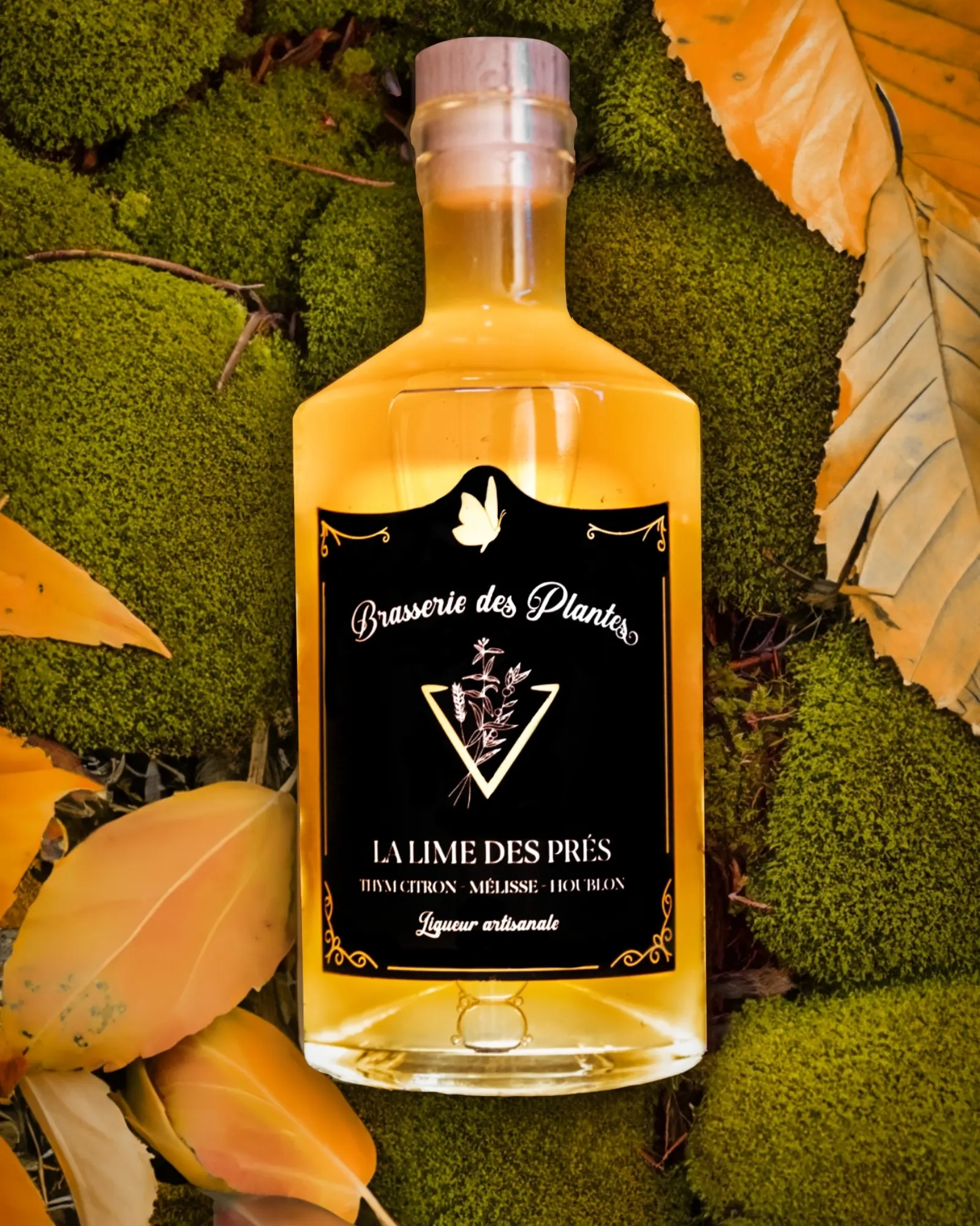
On the French market, 95% of liqueurs sold are industrial. Large distribution, of course, but also many “premium” brands that create illusion with careful packaging and founder stories told on the label.
The remaining 5% — real craft houses — represent a few hundred producers in France, including ours. They’re not just “small structures”. They’re people who choose each plant, taste each tank, fill each bottle by hand. And the difference in your glass is, we believe, considerable.
This article details the 7 concrete criteria that separate the two worlds. Without scorn for industry — which does its job — but with the transparency we owe anyone buying a bottle from our house.
1. Raw materials: freshness and origin
Industrial
Most large houses work from standardised aromatic extracts. Concentrates delivered in metal drums, dosed to the gram per a stable year-over-year formula. Advantage: production is constant, reproducible, non-seasonal. Disadvantage: fresh plants and their variations (vintage, parcel, weather) disappear in the process.
Worse, some groups use natural flavourings in the regulatory sense — which authorises the use of isolated molecules (enzymatically synthesised citral, purified linalol from lavandin) as long as they’re of plant origin. Legal. Not deceptive. But very far from whole plant.
Craft (us)
We work with whole fresh or dried plants, within 24 to 72 h of harvest. Each tank carries its vintage’s signature:
- June 2025 verbena doesn’t have the same profile as August 2024’s.
- A harvest after a dry week has more essential oils than a rainy one.
- The year’s batch is dated, tasted, sometimes adjusted.
It’s less reproducible (each year has its personality) — but that’s exactly the opposite of an industrial product. Our supply chain, in detail.
2. The production process: time and care
Industrial
Continuous production. Plants (or their extracts) are mixed with alcohol and sugar syrup, stirred, filtered, bottled. Everything can be done in 48 to 72 hours per batch. Equipment is automated: tanks of several tens of thousands of litres, industrial filtration, high-speed bottling.
Craft
Batch-based production, with rest periods. Each lot goes through:
- a long infusion period (several weeks),
- a decanting and blending period,
- a rest before bottling so aromas harmonise.
For L’Alchimie Végétale, our World’s Best Digestif 2025, total time is 4 to 6 months between harvesting the first plants and bottling. For L’Herbe des Druides Oak Cask, which goes through barrel before bottling, it’s 12 to 18 months.
You can’t “speed this up” without betraying the product. Patience is part of the process.
3. Sugar: less to let the plants speak
Industrial
Common sugar level: 250 to 400 g/L. Why?
- Sugar masks aromatic flaws of a standardised extract.
- It gives a “rich” mouthfeel that appeals to soda-accustomed consumers.
- It allows producing with less noble or past-prime plants.
An industrial crème at 350 g/L is as sweet as a soda, sometimes sweeter.
Craft (us)
Our liqueurs average 120 to 180 g/L, in the low end of regulation (100 g minimum). It’s not a marketing choice, it’s a product constraint: any more and you’d no longer hear the plant.
Consequence: our liqueurs have a finish (length in mouth) fundamentally different. Instead of a sweet peak that falls off, they open a 30-60 second aromatic plateau. What professional tasters call “persistence”.
4. Colourings and additives: nothing hiding the material
Industrial
Almost systematic, because plants’ natural colour is variable (displeasing to marketing directors) and pale (less “premium” visually). Common authorised colourings:
- E150d (ammonia caramel) — for brown digestifs. Adds deep brown colour.
- E102 (tartrazine, yellow) — for verbena, mint, Chartreuse imitations.
- E133 (brilliant blue) — for some exotic liqueurs.
Add preservatives (sulphites E220, benzoates E211), stabilisers (arabic gum E414), thickeners (glycerine E422).
Craft (us)
Only the plant gives the colour:
- L’Alchimie Végétale gets its deep amber from cinnamon, gentian and cane sugar caramel (not E150d).
- Menthor is pale olive green — not neon green — because that’s the natural colour of a real mint infusion.
- Elderberries give limited editions a natural violet hue, variable year on year.
Our labels always list the complete ingredients. Zero E-xxxx. Alcohol (from European organic beetroot), water, sugar, plants. Period.
5. Batch size: bottles per year, actual numbers
Industrial
Public orders of magnitude:
- Grand Marnier: ~20 million bottles/year.
- Chambord (Brown-Forman): ~4 million/year.
- Suze (Pernod Ricard): ~5 million/year in France.
- Cointreau: ~13 million/year.
Craft
- Chartreuse (large craft French house): ~1.5 million/year across all cuvées.
- Bénédictine: a few hundred thousand/year.
- Us, La Brasserie des Plantes: between 30,000 and 40,000 bottles/year across 18 references. Some limited editions like L’Alchimie Cuvée Michel don’t exceed 500 bottles/year.
Why does this matter for you? Because:
- Quality control is manual at our scale. Every tank tasted before bottling, every lot tasted at 3 stages.
- The raw material can be traced plant by plant. There aren’t 10 tonnes of organic mountain verbena in France. There are a few hundred kilos per year, and that’s plenty for our production.
- The producer can personally reply. Write to us via contact: you’ll get an answer signed by Étienne or Guillaume within 48 h.
6. Traceability: detailed origin from field to bottle
Industrial
Test it yourself: call a major brand’s consumer service and ask “Exactly where do the plants in your liqueur X come from?”. You’ll get a vague answer: “our European sourcing”, “plants selected in Europe”, “approved suppliers”. Rarely more.
It’s not bad faith — it’s a consequence of multi-origin industrial sourcing. Aromatic extracts are assembled by brokers aggregating production from dozens of countries. Traceability often stops at country level, rarely farm level.
Craft (us)
Our 11 partner producers are named:
- 2 professional gentian harvesters (yellow gentian root, harvested at 1,000–1,600 m altitude).
- 4 aromatic-plant growers (verbena, coriander, mint, thyme), most of them organic.
- 2 certified professional foragers (trained by a Regional Natural Park, for wild elderflower and wild thyme).
- 2 beekeepers (for our honeys).
- 1 organic arboriculturist (bitter-orange zest, heritage apples).
Detailed article on our producers.
If a bottle you bought shows a defect, we can trace in 24 h back to the tank, the harvest, the producer, the field. First time anyone’s asked (in 5 years, zero complaints) — but it’s ready.
7. Price: what it actually pays for
This often surprises. Why does a craft liqueur cost €35-45 when large distribution sells at €9-15?
Breakdown of an industrial price
On a liqueur sold €12 retail inc. VAT in a supermarket:
- VAT (20%): €2
- Distributor margin (35%): €3.5
- Packaging, logistics, marketing: €2
- Actual production cost: about €4.5
At this price, you’re paying neither for fresh French plants nor human craft — you’re paying for an aromatic extract and neutral alcohol automatically bottled.
Breakdown of a craft price
On L’Alchimie Végétale sold €45 inc. VAT on our online shop:
- VAT (20%): €7.5
- Logistics, payment fees, hosting: €3
- Packaging (bottle, cap, labels): €2.5
- Organic alcohol + cane sugar: €4
- 27 organic plants (gentian, cinnamon, cardamom, etc.): €8
- Human time (harvest, prep, bottling, labelling): €10
- Net margin to finance the company: €10
That’s about €22 of pure production cost per bottle, excluding salaries. 2.5× the total retail price of a discount liqueur.
When you buy from us, nearly half the price directly finances:
- French organic producers.
- Professional foragers from the Natural Parks.
- Pilat beekeepers.
- The 3 partners’ salaries.
The rest (VAT, logistics, glass, labels) is incompressible, the same for all actors.
Conclusion: it’s not “better” in absolute terms, it’s different
An industrial liqueur isn’t a bad product. It’s a different product, designed for:
- low price,
- mass availability,
- year-to-year stable profile,
- mass consumption.
A craft liqueur is designed for:
- a real terroir and a real season,
- rarer, more intense consumption,
- support to a regional agricultural chain,
- a singularity industry cannot reproduce.
The choice is personal. But it shouldn’t be made through ignorance. Now you know.
The “30-second label test”
Next time you’re at a supermarket or wine merchant, pick up a bottle and check these 4 points:
- ✅ Named plant list (not just “plants” or “natural flavourings”).
- ✅ Origin mention (region, country, producer).
- ✅ No colourings (no E-xxxx in ingredients).
- ✅ Sugar level below 250 g/L (shown in nutritional values).
If all 4 are ticked, you’re probably facing an honest craft house. If fewer than 3, keep looking.
Bonus: test by comparison. Buy an industrial bottle and a craft bottle of the same style (e.g. an industrial bitter and our Cerf’Gent). Taste blind with a friend. The difference is obvious.
Read next:
- How to choose a craft liqueur — complete guide — the 5 objective criteria
- The plants in our liqueurs — a botanical journey
- Partner foragers and growers — how we source our plants
- Two friends, one liqueur house — how it all started in 2021
Or test it directly: build your own 3-bottle gift box and compare for yourself.
Co-founder of La Brasserie des Plantes. A former restaurateur in Saint-Étienne, he designs cocktail pairings and the product narrative.