

The plants in our liqueurs: a botanical journey
Lemon verbena, yellow gentian, elderberry, lemon balm, wild thyme… 12 plants that make up our liqueurs, sourced from our partner foragers and growers (most of them organic).
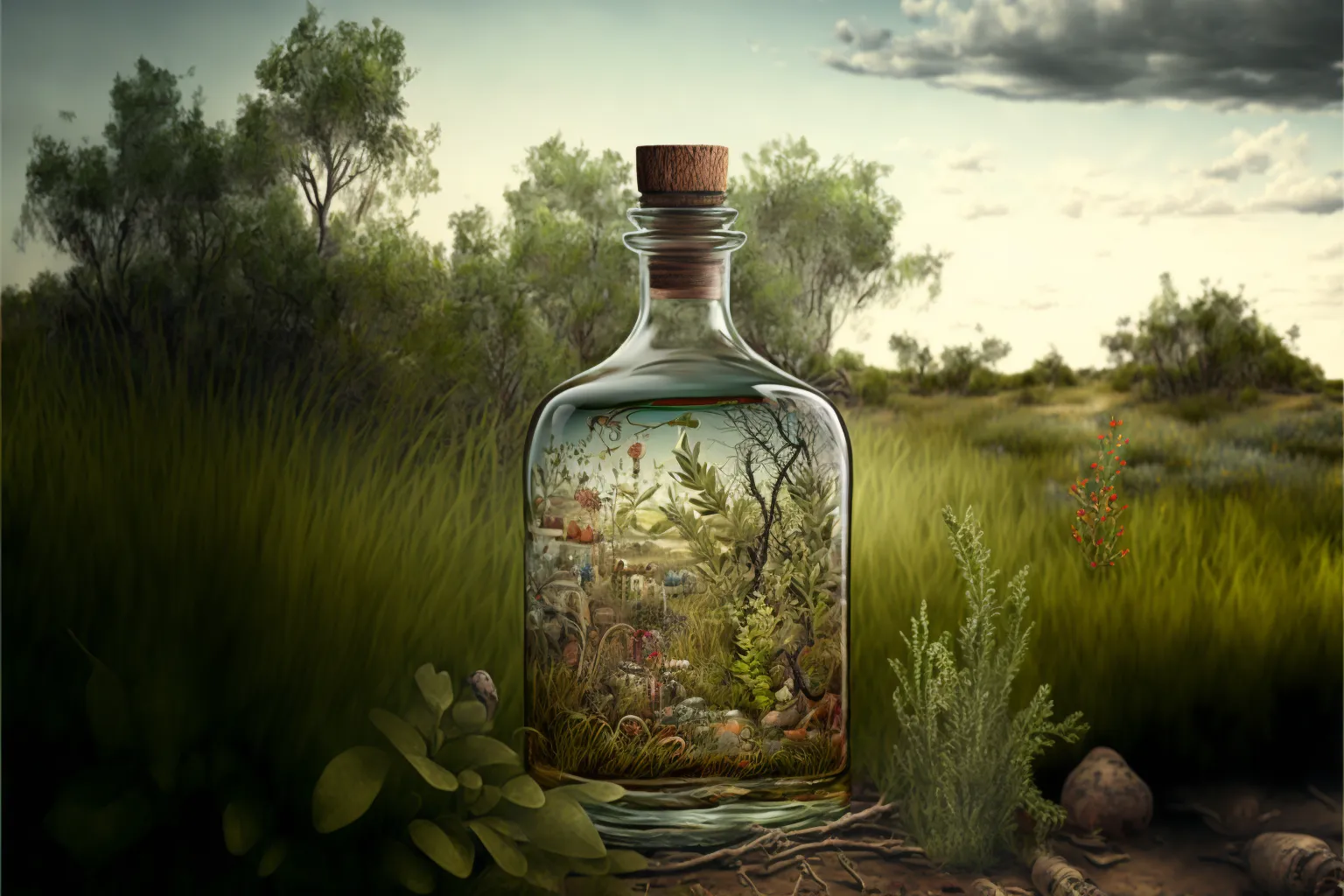
When people ask us what makes our liqueurs different from those of larger houses, the answer is one word: the plants.
We don’t grow them ourselves. We select them from foragers, market gardeners, cooperatives and specialist suppliers — most of them organic, not all. Our workshop is in Saint-Didier-en-Velay (Haute-Loire, France): that’s where production and bottling happen, by hand.
This guide is the botanical journey of a bottle. 12 signature plants, their identity, their use, and which of our liqueurs they end up in.
Why mid-mountain regions are the cradle of plant liqueurs
Europe’s great liqueur houses — Chartreuse (Isère), Bénédictine (Normandy), Suze (Auvergne) — all emerged from mid-mountain zones. Three botanical reasons explain this geography:
- Varied altitude. Each climatic tier hosts its own species: elder in valleys, wild thyme mid-slope, gentian on high plateaus.
- Volcanic geology (basalt, granite). Soils are poor in organic matter but rich in trace elements — concentrating plants’ aromatic principles.
- Semi-mountain climate with strong day/night amplitudes. Cool nights force plants to produce defensive compounds (essential oils, tannins) that give them their gustatory interest.
Saint-Didier-en-Velay, where our workshop is, sits at 740 metres altitude.
Plants grown by our partner market gardeners
The biggest share of our raw material comes from partner market gardeners and foragers, most of them organic, who deliver at the rhythm of each harvest.
1. Lemon verbena (Aloysia citrodora)
Our totem plant. The one we harvest most, the one that perfumes our workshop in July-August when we compose the first batches.
- Botanical origin: South America, naturalised in Southern France in the 19th century.
- Aromatic profile: lemon, melissa, light mentholated finish.
- Harvest: 3 passes per year, always by hand, in the morning before the sun evaporates the essential oils.
- Use at our house: signature of L’Herbe des Druides. Present in 14 of our 18 liqueurs as a secondary note.
2. Lemon balm (Melissa officinalis)
The European cousin of verbena — softer, more “honey”, less citric.
- Origin: Mediterranean basin, cultivated in Europe since Antiquity (already noted by Pliny the Elder).
- Profile: soft lemon, acacia honey note, soothing finish.
- Harvest: June-July, just before flowering (max essential oil content).
- Use at our house: floral colouring in L’Alchimie Végétale and several of our aperitifs.
3. Wild mountain thyme (Thymus serpyllum, “serpolet”)
Wild mountain thyme — not the common thyme from supermarkets. Far more potent aromatically.
- Botanical origin: grows wild on stony mid-mountain slopes.
- Profile: concentrated thyme, peppery note, resinous finish.
- Harvest: July-August, at flowering, on south-facing slopes, by our partner foragers.
- Use at our house: camphor touch in L’Herbe des Druides and L’Alchimie Végétale.
4. Rare aromatics
Some of our partner market gardeners also grow uncommon aromatic plants:
- Southernwood (Artemisia abrotanum) — southern wormwood, lemon-absinthe-light profile.
- Hyssop (Hyssopus officinalis) — bitter, spicy, widely used in monastic elixirs.
- Lemon thyme (Thymus × citriodorus) — natural hybrid, thyme + verbena.
- Mexican tarragon (Tagetes lucida) — anise-like, subtler than classic tarragon.
These 4 plants are the “finishing touches” in our most complex compositions.
The 6 plants foraged or grown by our partners
5. Yellow gentian (Gentiana lutea)
The queen of mountain bitters. The emblematic plant of mid-mountain regions, giving its characteristic bitterness to our Cerf’Gent.
- Botanical origin: plateaus of 1,000 to 1,600 m altitude. Protected plant, regulated harvest.
- Profile: frank bitterness, earthy note, long rooty finish.
- Harvest: October-November, before first frosts. The root is dug by hand, with a “Devil’s fork” (traditional tool).
- Our partners: professional gentian harvesters — a rare trade.
A gentian harvester is a rare trade — fewer than 100 people in France. They work standing, bent over, in rain or frost. A workday = 30 to 50 kg of fresh roots. After drying (which divides weight by 3), that gives about 15 kg of dried gentian ready to work.
Read more about our partner foragers and growers.
6. Black elder (Sambucus nigra)
A shrub very common in countryside hedgerows. We use its flowers in spring and its berries in late summer.
- Botanical origin: hedges, woodland edges, wet zones. Wild, abundant.
- Flower profile: muscat, white grape note, fresh floral finish.
- Berry profile: dark fruit, roundness, wild blackberry note.
- Harvest: flowers in May-June, berries in August-September.
- Our partners: professional foragers (Regional Natural Park training).
- Use at our house: heart of Nectar d’Ostara (flowers) and some limited editions (berries).
7. Wild blueberry (Vaccinium myrtillus)
Not the cultivated blueberry (North American), but this one: small, black, wild, from mid-mountain undergrowth.
- Botanical origin: high-altitude forests.
- Profile: dark fruit, fine tannins, present acidity, long finish.
- Harvest: August, metal comb for professionals, hand for small gathers.
- Use at our house: limited editions only, confidential production.
8. Fruits from a partner grower
A partner arboriculturist supplies us:
- Bitter orange — zest only, used in Zéleste for its citrus bitterness.
- Heritage apples (Canada reinette, rose of Berne) — some limited editions.
9-11. Imported plants (and why)
Let’s be transparent: some plants don’t grow in France and we import them from European organic wholesalers specialised in herbalism. This is the case for:
- Ceylon cinnamon (Sri Lanka) — in L’Alchimie Végétale and a few limited editions.
- Green cardamom (Guatemala, India) — exotic touch in our complex digestifs.
- Combava lime (Réunion Island) — kaffir-citrus note in Zéleste.
- Star anise (Vietnam) — anise heart of some compositions.
- Liquorice (Italy / Greece) — roundness and structure.
About 15% of our raw material is thus imported. We don’t claim “all local” — importing Ceylon cinnamon to make “local cinnamon” would be absurd.
The harvest calendar
A quick overview of what happens on our side through the seasons:
| Period | Harvests | What’s happening at the workshop |
|---|---|---|
| April-May | Elderflower, first verbena, wild garlic | Start of spring compositions |
| June-July | Lemon balm, verbena (1st pass), rare aromatics | Peak production — tonnes of plants come in |
| August-September | Verbena (2nd pass), wild thyme, blueberry, elderberry | Fruit-forward limited edition prep |
| October-November | Gentian (root), final fruits | Last big harvest of the year |
| December-March | Garden rest | Final assemblages, tests, tastings, N+1 planning |
The “forgotten” plants we bring back
One of our commitments is to reintroduce into modern use plants that traditional herbalism valued but industry forgot:
- Southernwood (Artemisia abrotanum) — used since the Middle Ages, disappeared from commercial liqueurs.
- Butcher’s broom (Ruscus aculeatus) — already mentioned by Dioscorides (1st century). Rare use in modern liqueur.
- Common centaury (Centaurium erythraea) — powerful bitter, known as “European cinchona”.
- Sweet woodruff (Galium odoratum) — flavoured Rhine wines in the Middle Ages.
These plants are rarely commercialised in long supply chains. We work directly with foragers who can identify them in the wild.
How to recognise a real craft sourcing
Many houses highlight a regional origin on their labels. It’s a strong, sometimes vague marketing argument. Here’s how to distinguish real from fake:
- The house names its producers (at least by category, ideally by name).
- It can detail the journey of a plant from field to bottle.
- The harvest calendar matches natural seasonality (no verbena in December).
- Photos or videos exist of the producers — not just packaging.
- The producer accepts visits by appointment.
Come meet us — the workshop is open Wednesday to Saturday.
A final word on altitude
A specificity worth remembering: the higher a plant grows, the more aromatically concentrated it is.
At 400 m, a verbena grows quickly, makes many leaves, but its essential oils are diluted.
At 900 m, it grows less, makes less biomass — but each leaf is 2 to 3 times richer in citral (the molecule giving its fragrance).
That’s why we don’t aim for tonnage. We make less but better — and you can taste it.
Read next:
- How to choose a craft liqueur — complete guide
- Partner foragers and growers — how we source our plants
- Forgotten plants — 7 species coming back to our glasses
- Discover the 12 plants in our range — detailed profiles
Or browse the full shop — 13 liqueurs.
Co-founder of La Brasserie des Plantes. Trained in plant biotechnology in Toulouse, he composes the recipes and oversees production.